Growing a startup is exciting, but expanding a team also brings new challenges. When a Dallas-Fort Worth business moves from a small group of employees toward a team of 50, informal processes that once worked can become difficult to manage. Hiring decisions take more time, managers need clearer guidance, and employees expect consistent communication, training, and support.
The solution is not necessarily to build a large HR department overnight. Instead, founders can establish practical systems that make everyday people management easier and prepare the company for sustainable growth.
This checklist covers the HR priorities that Texas startups can address as they approach their first 50 employees, with an emphasis on organization, employee experience, and operational efficiency rather than detailed legal requirements.
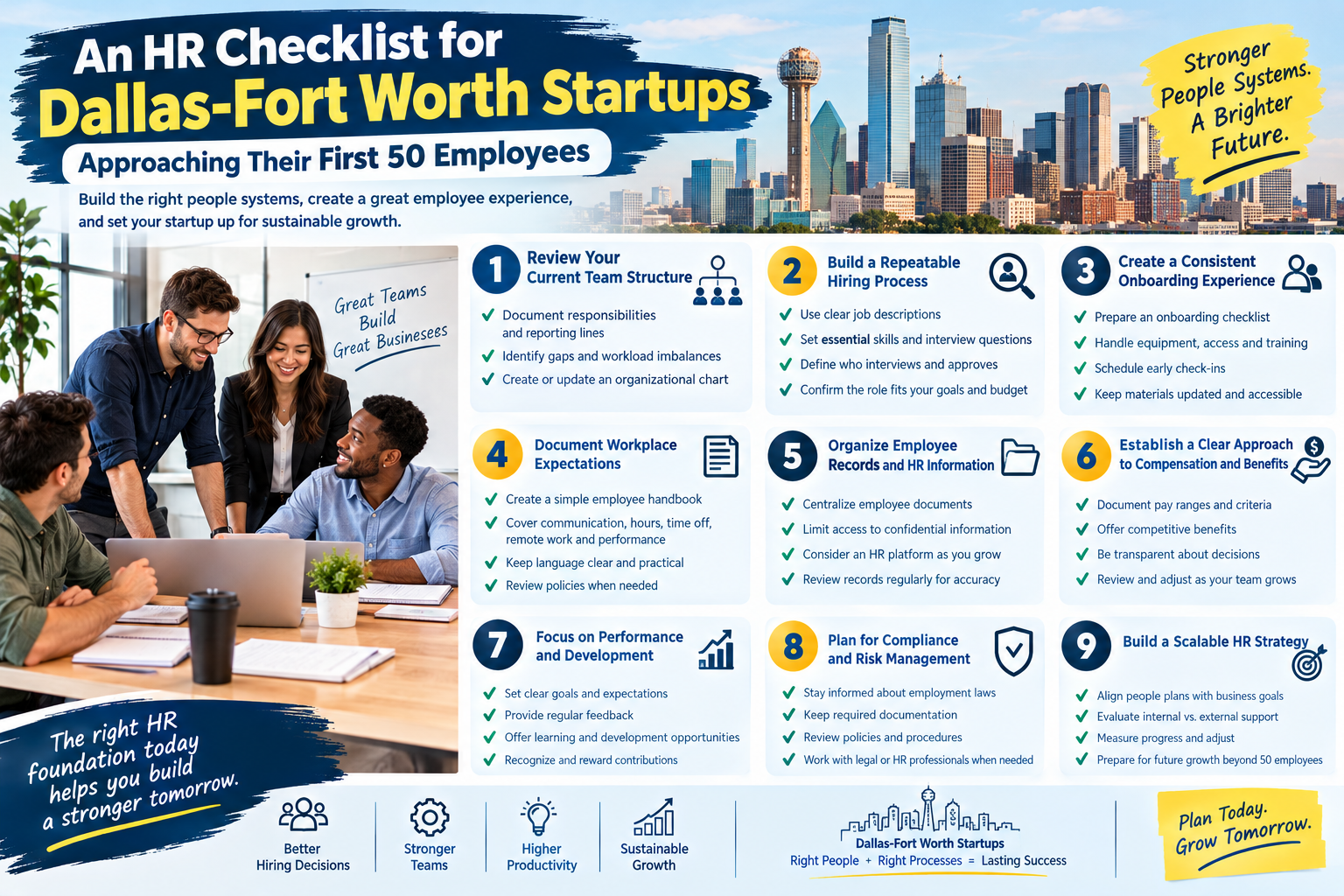
1. Review Your Current Team Structure
Before hiring more employees, take a clear look at the team you already have. Startup employees often handle several responsibilities, and their duties may change as the business develops. Without clear expectations, this flexibility can lead to duplicated work or important tasks being overlooked.
Start by documenting each employee’s primary responsibilities, reporting relationships, and current workload. Identify positions where the team depends too heavily on one person and functions that may need additional support.
A simple organizational chart can help employees understand who makes decisions, who manages each function, and where questions should be directed. Review this structure whenever the business introduces a new department, manager, or major responsibility.
See also: Transportation Technology Trends for the Future
2. Build a Repeatable Hiring Process
Hiring becomes more complicated when several roles need to be filled at the same time. Founders may initially manage interviews themselves, but relying on memory and informal conversations can make candidate evaluations inconsistent.
Create a standard hiring process that includes an approved job description, a list of essential skills, consistent interview questions, and a clear method for comparing candidates. Decide who participates in interviews and who has final approval.
Before opening a position, confirm that the business genuinely needs the role and has a realistic budget for it. This helps prevent rushed hiring decisions that do not support the company’s priorities.
For growing teams, Talento can be a useful resource to explore when a startup wants additional guidance on its people-management and staffing needs.
3. Create a Consistent Employee Onboarding Experience
A new employee’s first few days can influence how quickly they become productive and how connected they feel to the company. A startup does not need an elaborate onboarding program, but it should have a reliable process that every new hire can follow.
Prepare a checklist covering the employee’s equipment, email account, software access, introduction to colleagues, role expectations, and initial training. Assign a specific person to coordinate these tasks so that responsibilities do not fall between departments.
Managers should also schedule check-ins during the employee’s first weeks. These conversations provide an opportunity to answer questions, clarify priorities, and identify problems before they become frustrating.
As the company grows, keep onboarding materials in one accessible location and update them whenever internal processes change.
4. Document Everyday Workplace Expectations
Small teams often operate through verbal agreements and informal messages. Although this can be convenient initially, it becomes harder to maintain consistency when several managers oversee different groups.
Create a straightforward employee handbook or internal guide that explains how the business operates. Depending on the company’s needs, it might cover communication channels, working hours, time-off request procedures, remote-work expectations, performance conversations, and the appropriate process for raising workplace concerns.
Keep the language clear and practical. Employees should be able to find answers without asking the founder to explain the same process repeatedly.
Because workplace expectations and applicable requirements can vary, have appropriate professionals review policies when needed. The goal is to establish consistent internal guidance without making routine work unnecessarily complicated.
5. Organize Employee Records and HR Information
Employee information can become scattered across spreadsheets, email accounts, shared folders, and paper documents as a startup expands. This makes it harder to locate information, update records, and maintain an accurate view of the workforce.
Establish a central system for organizing employee records, onboarding documents, job descriptions, training information, and relevant performance notes. Limit access to confidential information according to each person’s responsibilities.
A dedicated HR platform may become worthwhile as the business grows, but a well-organized and appropriately secured system can be a practical starting point for a smaller team.
Review records periodically to identify missing information, outdated documents, and inconsistent naming or filing practices. Good organization saves time and helps managers make decisions using reliable information.
6. Establish a Clear Approach to Compensation and Benefits
As hiring increases, employees may compare responsibilities, pay, benefits, and opportunities for advancement. If compensation decisions are made without a consistent approach, managers may struggle to explain differences between similar roles.
Start by documenting the responsibilities and experience associated with each position. Research relevant market information, define reasonable pay ranges where practical, and establish who approves compensation changes.
Also, make sure employees understand the benefits and workplace resources available to them. Clear communication can reduce confusion and help new hires evaluate the overall employment experience.
A growing company does not need an elaborate compensation department immediately. It does need a thoughtful process that supports consistent, explainable decisions.
7. Give Managers Practical HR Guidance
By the time a startup approaches 50 employees, founders may no longer be able to handle every employee question or workplace issue personally. Team leaders need guidance on communication, feedback, workload planning, and performance concerns.
Provide managers with a simple framework for conducting one-on-one meetings, setting expectations, documenting important discussions, and escalating sensitive concerns. Encourage them to address routine issues promptly rather than allowing misunderstandings to continue.
Managers should also know when a question requires specialist advice instead of an informal decision. This is particularly valuable when the business has grown quickly and new managers have limited experience supervising others.
8. Introduce Regular Performance and Feedback Conversations
Employees need to understand what successful performance looks like and how their work contributes to business goals. Waiting until an annual review to discuss problems or recognize achievements can leave both employees and managers without useful direction.
Establish regular check-ins that cover progress, challenges, priorities, and professional development. Set clear objectives for each role and revisit them when business needs change.
Keep the process proportionate to the company’s size. Short, consistent conversations are often more useful than complicated review forms that nobody has time to complete.
Encourage employees to share feedback about management, workload, and internal processes. Their observations can reveal issues that leadership might otherwise miss.
9. Decide When Outside HR Support Makes Sense
Founders often manage HR alongside sales, operations, fundraising, and customer service. As the team expands, this arrangement can become difficult to sustain.
Consider outside HR consulting when hiring becomes difficult to coordinate, managers repeatedly need guidance, employee records require better organization, or leadership lacks the time to improve internal processes.
An external HR professional can help review existing workflows, develop practical policies, improve onboarding, and establish a clearer approach to employee management. Depending on the startup’s needs, support might be project-based or ongoing.
Rather than waiting for every process to become a problem, identify the areas where expert input could save time and help the business prepare for its next stage.
10. Review the Checklist Every Quarter
An HR checklist should change as the company grows. A process that works for ten employees may not be sufficient for a team spread across several departments or locations.
Schedule a quarterly review to evaluate hiring plans, onboarding feedback, employee records, manager support, compensation practices, and unresolved workplace concerns. Ask department leaders which processes are working and where employees are experiencing unnecessary friction.
Prioritize improvements according to their business impact. There is no need to introduce every HR tool or policy at once; focus first on the gaps that affect employees, managers, and daily operations.
Conclusion
For Dallas-Fort Worth startups approaching their first 50 employees, effective HR management begins with practical foundations. Clear roles, repeatable hiring, organized records, consistent onboarding, manager guidance, and regular feedback can make growth easier to manage.
Founders do not need to create a complicated HR department immediately. By reviewing these priorities regularly and seeking outside expertise when appropriate, startups can build a more organized workplace, support their employees, and prepare for continued growth.