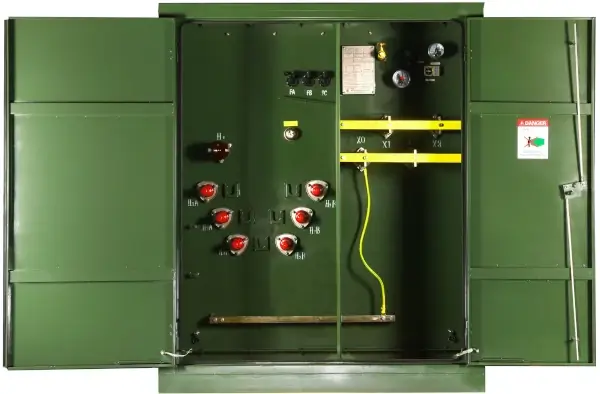
A 100kva transformer is commonly used for distributing electrical power to commercial buildings, workshops, small manufacturing facilities, agricultural sites, and other installations with moderate electrical demand. Its 100 KVA rating provides enough capacity for a range of lighting, HVAC, machinery, pumps, and general electrical loads without requiring the larger equipment used by heavy industrial facilities.
Choosing the right transformer requires more than checking the KVA rating. Voltage levels, phase configuration, installation environment, load characteristics, efficiency, and future expansion should all be considered before purchasing or installing the equipment.
What Does 100 KVA Mean?
KVA stands for kilovolt-amperes and represents the apparent power capacity of a transformer. A 100kva transformer is designed to handle an apparent power load of 100 KVA under its specified operating conditions.
The amount of usable power in kilowatts depends on the power factor of the connected equipment. For example, at a power factor of 0.8:
100 KVA × 0.8 = 80 kW
At a power factor of 0.9:
100 KVA × 0.9 = 90 kW
The actual permissible loading depends on the transformer’s design, ambient temperature, cooling method, insulation system, and manufacturer’s specifications.
Common Applications
A 100kva transformer can be used in many installations where the electrical demand falls within its rated capacity. Common applications include:
- Small manufacturing units
- Commercial buildings
- Workshops
- Retail stores
- Schools and institutional buildings
- Agricultural facilities
- Warehouses
- Small hotels and restaurants
- Pumping stations
- Construction sites
- Residential developments
The connected load should be assessed before selecting the transformer. Equipment with high starting currents, such as motors and compressors, may require additional consideration even when the calculated running load appears to be within 100 KVA.
Dry-Type and Oil-Filled Transformers
Transformers with a 100 KVA rating are available in different construction types, with dry-type and oil-filled designs being common choices.
Dry-type transformers use solid insulation rather than liquid insulation. They are often selected for indoor applications, commercial properties, and locations where oil-filled equipment may not be practical.
Oil-filled transformers use insulating oil for electrical insulation and heat transfer. They are frequently used for outdoor installations and electrical distribution systems where this type of cooling and insulation is appropriate.
The choice depends on factors such as available space, fire-safety requirements, environmental conditions, maintenance arrangements, and project specifications.
Voltage Configuration
Voltage requirements must be established before ordering a 100kva transformer. The primary voltage needs to match the incoming electrical supply, while the secondary voltage must suit the equipment or distribution system connected to the transformer.
A transformer specification may include:
- Primary voltage
- Secondary voltage
- Frequency
- Number of phases
- Vector group
- Winding configuration
- Impedance
- Tap settings
- Cooling method
- Insulation class
For industrial and commercial applications, three-phase transformers are frequently used because they are suitable for distributing power to motors, machinery, HVAC systems, and other three-phase equipment.
Load Assessment Matters
A transformer should not be selected solely by adding up the nameplate ratings of every connected device. Electrical engineers generally consider demand factors, diversity, power factor, motor starting currents, operating schedules, and anticipated future loads.
For example, a facility may have equipment with a combined nameplate capacity greater than 100 KVA but may not operate all of it simultaneously. Conversely, equipment with substantial starting current may create short-duration demands that need to be considered during transformer selection.
Future expansion should also be included in the planning process. If additional machinery or electrical equipment is expected to be installed later, the transformer should have an appropriate capacity margin.
Efficiency and Transformer Losses
Transformers consume energy through losses even though they do not generate power themselves. These losses are generally categorized as no-load losses and load losses.
No-load losses occur while the transformer remains energized, regardless of how much power is being consumed by connected equipment. Load losses increase as the transformer carries more current.
For facilities where the transformer operates continuously, efficiency can affect long-term operating costs. Comparing transformer losses alongside the purchase price provides a more useful picture of the total cost of ownership.
Operating a transformer significantly below its intended loading range can also affect efficiency. On the other hand, regularly operating close to its maximum capacity can increase thermal stress and reduce the available margin for additional loads.
Installation Requirements
Installing a 100kva transformer requires suitable space, ventilation, electrical clearances, grounding, and protection.
Outdoor installations may require fencing, weather protection, drainage, physical barriers, and appropriate cable arrangements. Indoor installations need adequate ventilation because transformer operation produces heat.
The installation should also include appropriate protective equipment. Depending on the electrical system, this may involve circuit breakers, fuses, surge protection, temperature monitoring, and other protection devices.
Grounding is another essential part of the installation. The transformer enclosure, neutral system, and related electrical equipment should be grounded according to applicable electrical standards and project requirements.
Maintenance and Inspection
Regular inspection can help detect developing problems before they cause equipment failure or an unexpected shutdown.
For oil-filled transformers, maintenance may include checking oil levels, inspecting for leaks, examining bushings and connections, and testing the condition of the insulating oil where required.
Dry-type transformers require inspection of connections, insulation, ventilation openings, and accumulated dust or debris. Loose electrical connections can create localized heating and should be addressed during scheduled maintenance.
Thermal imaging can also be used to identify abnormal temperature patterns around electrical connections and transformer components.
Maintenance intervals should follow the manufacturer’s recommendations as well as the operating environment and applicable electrical standards.
Selecting the Right Supplier
The technical specification should be clearly established before comparing suppliers. A reliable supplier should be able to provide information covering transformer ratings, efficiency, losses, dimensions, weight, insulation, impedance, cooling arrangement, testing, and applicable standards.
Factory testing can provide additional verification that the transformer meets the specified electrical and mechanical requirements.
Warranty coverage, spare-parts availability, technical support, delivery schedules, installation assistance, and commissioning support may also influence the purchasing decision.
Conclusion
A 100kva transformer can provide an effective power-distribution option for commercial, agricultural, institutional, and light industrial applications with moderate electrical demand. Its suitability depends on more than its 100 KVA rating.
Voltage requirements, load characteristics, cooling method, efficiency, installation conditions, protection systems, and future capacity requirements should all be reviewed before purchase.
A properly specified transformer can provide stable power distribution and dependable operation for many years. Starting with an accurate load assessment and a clear technical specification helps ensure that the selected transformer matches both current requirements and the expected operating conditions of the facility.